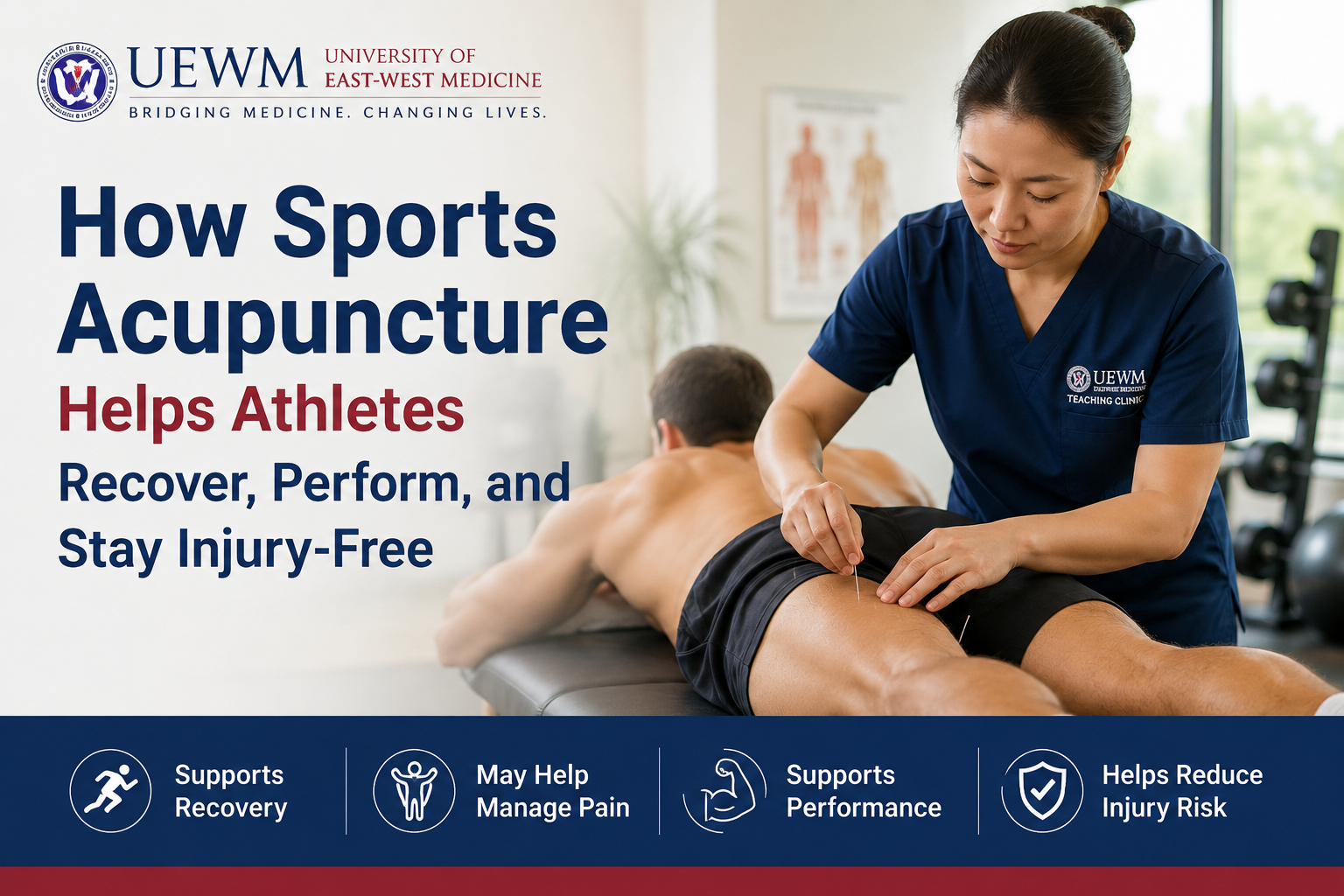
How Sports Acupuncture Helps Athletes Recover, Perform, and Stay Injury-Free | UEWM
Sports acupuncture may help active people manage pain, muscle soreness, and recovery—but it is not a guarantee against injury. Athletes, runners, weightlifters, gym members, martial artists, and active adults may use acupuncture as one part of a broader recovery plan that also includes appropriate medical care, rehabilitation, rest, nutrition, hydration, and carefully managed training.
Training places repeated demands on muscles, joints, tendons, and the nervous system. When exercise volume, intensity, technique, sleep, or recovery becomes unbalanced, an active person may experience soreness, stiffness, reduced mobility, or pain.
Sports acupuncture applies traditional acupuncture principles within the context of physical activity, athletic recovery, and musculoskeletal care. Treatment is individualized according to the person’s symptoms, health history, activity level, and goals.
What Is Sports Acupuncture?
Acupuncture involves the insertion of very thin, sterile needles at selected points on the body. A practitioner may choose points near an uncomfortable area as well as points elsewhere on the body based on the treatment plan.
In a sports or fitness setting, acupuncture may be considered for concerns involving muscle tension, soreness, pain, restricted movement, or recovery after strenuous activity. It may also be used alongside physical therapy, medical treatment, corrective exercise, mobility work, or other rehabilitation services.
Acupuncture should not replace an appropriate medical examination when a serious injury, fracture, concussion, infection, neurological problem, or other urgent condition may be present.
Who May Consider Sports Acupuncture?
Sports acupuncture is not limited to professional athletes. It may be considered by many physically active people, including:
- Runners and walkers
- Weightlifters and bodybuilders
- Gym members and fitness beginners
- Cyclists and swimmers
- Martial artists
- Yoga and Pilates participants
- Recreational sports players
- Weekend athletes
- Active older adults
- People returning gradually to exercise
The treatment plan should reflect the person’s health, diagnosis, training demands, medications, previous injuries, and current recovery needs.
How Acupuncture May Support Athletic Recovery
Helping Manage Pain
Pain can interfere with movement, sleep, training quality, and everyday activity. Research suggests that acupuncture may help some people manage certain types of musculoskeletal and chronic pain. Results differ between individuals and conditions, and the strength of evidence is not equal for every sports-related complaint.
Addressing Post-Exercise Muscle Soreness
Delayed-onset muscle soreness, often called DOMS, can appear after unfamiliar or strenuous exercise. It commonly develops during the first day after training and may remain noticeable for several days.
Some systematic reviews have reported possible reductions in post-exercise soreness and improvements in recovery measures after acupuncture. However, study quality and treatment methods vary, so acupuncture should be viewed as a possible recovery tool rather than a guaranteed solution.
Supporting Comfortable Movement
Pain, tightness, and guarding can affect how a person moves. When symptoms improve, an athlete may find it easier to participate in prescribed mobility work, rehabilitation exercises, or gradual training.
Improved comfort does not necessarily mean that an injured tissue has completely healed. Returning to full activity should be based on function, strength, medical guidance when needed, and the demands of the sport.
Supporting a Broader Recovery Routine
Recovery is not created by one treatment. It depends on several connected factors:
- Appropriate rest between demanding sessions
- Gradual increases in training volume
- Good exercise technique
- Adequate sleep
- Balanced nutrition
- Hydration
- Strength and mobility work
- Rehabilitation when necessary
- Stress management
Acupuncture may complement these practices, but it should not be used to ignore pain while continuing an unsafe training program.
Can Acupuncture Improve Athletic Performance?
Some studies have examined heart-rate recovery, perceived exertion, muscle soreness, strength, mobility, and other performance-related outcomes. Certain findings are encouraging, particularly in areas related to recovery and soreness.
However, current evidence does not justify promising that acupuncture will make every athlete faster, stronger, or more resistant to injury. Performance depends on training quality, coaching, conditioning, technique, nutrition, sleep, genetics, health, and many other factors.
A more responsible goal is to use acupuncture, when appropriate, to support symptom management and recovery so the athlete can participate more comfortably in a well-designed training or rehabilitation plan.
Common Concerns Active People May Discuss With an Acupuncturist
An active person may seek an acupuncture consultation for concerns such as:
- Muscle soreness or tightness
- Low-back discomfort
- Neck and shoulder tension
- Knee discomfort
- Elbow or forearm pain
- Hip tightness
- Foot or heel discomfort
- General stiffness after training
- Recovery after strenuous exercise
- Difficulty relaxing between training sessions
These symptoms can have many different causes. A qualified practitioner should assess whether acupuncture is appropriate and whether the person should first be evaluated by a physician, physical therapist, or another healthcare professional.
What to Expect During a Treatment
A typical appointment begins with a health history and discussion of the person’s symptoms, activity, previous injuries, medications, and treatment goals.
The practitioner may evaluate posture, movement, tenderness, or other relevant findings. Very thin, sterile, single-use needles are then inserted at selected points. The number and location of needles vary according to the individual treatment plan.
Some people feel little or no discomfort during insertion. Others may notice temporary heaviness, tingling, warmth, or a dull sensation. Mild soreness or bruising can occasionally occur after treatment.
Patients should tell the practitioner about pregnancy, bleeding disorders, blood-thinning medications, implanted medical devices, infections, fainting history, or other significant medical conditions before treatment.
Acupuncture Should Be Part of a Complete Injury-Management Plan
No responsible practitioner should promise that acupuncture alone will keep an athlete injury-free.
Injury risk may be influenced by training load, technique, conditioning, equipment, recovery, sleep, previous injuries, playing surface, age, health, and the physical demands of the activity.
A complete plan may include:
- Medical evaluation when symptoms are serious or persistent
- Physical therapy or rehabilitation
- Progressive strength training
- Mobility and flexibility work
- Technique correction
- Training-load management
- Rest and sleep improvement
- Nutrition and hydration support
- Acupuncture when clinically appropriate
Seek prompt medical care for severe pain, major swelling, deformity, inability to bear weight, sudden weakness, numbness, loss of coordination, chest pain, breathing difficulty, head injury, loss of consciousness, fever, or rapidly worsening symptoms.
Why Consider the UEWM Teaching Clinic?
The University of East-West Medicine provides affordable acupuncture services and supervised clinical care through its Teaching Clinic. The clinic gives patients access to acupuncture services while supporting the clinical education of future practitioners.
Teaching-clinic care may involve qualified student interns working under faculty supervision. Patients can ask questions about the treatment process, supervision, appointment availability, pricing, and whether the clinic is appropriate for their needs.
Connect With the UEWM Clinic
Active adults, athletes, gym members, and community residents interested in acupuncture may contact the University of East-West Medicine Clinic to ask about available services and appointments.
Clinic Phone: (408) 992-0218
Location: 595 Lawrence Expressway, Sunnyvale, CA 94085
Clinic Information: Explore UEWM Clinic Services
Frequently Asked Questions
Is sports acupuncture only for injured athletes?
No. Some active people seek acupuncture for pain or injury-related symptoms, while others consider it for muscle soreness, stiffness, relaxation, or recovery support. Treatment should be based on an individual assessment.
Can I exercise immediately after acupuncture?
That depends on the person, the treatment, and the reason for care. Light activity may be appropriate for some people, while others may be advised to rest or reduce training intensity. Ask the treating practitioner for guidance.
How many treatments will I need?
There is no universal number. The recommended schedule may depend on the condition, symptom duration, activity level, overall health, and response to treatment.
Is acupuncture safe?
Acupuncture is generally considered safe when performed by a properly trained practitioner using sterile needles and appropriate techniques. Temporary soreness, minor bleeding, bruising, dizziness, or fatigue can occur. Serious complications are uncommon but possible, which is why practitioner training and proper screening matter.
Can acupuncture replace physical therapy or medical treatment?
Not necessarily. Acupuncture is often used as a complementary service. Significant injuries and persistent symptoms may require medical diagnosis, imaging, rehabilitation, medication, or other treatment.
A Practical Approach to Better Recovery
Sports acupuncture may offer active people another option for managing pain, soreness, and recovery as part of a responsible healthcare and training plan.
The strongest approach combines individualized care with sound training, adequate recovery, good nutrition, quality sleep, appropriate rehabilitation, and timely medical evaluation.
Acupuncture may support the process, but staying healthy and active requires attention to the entire recovery system—not one treatment alone.
This article is provided for general educational purposes and is not medical advice. Acupuncture results vary, and no treatment can guarantee improved performance or prevention of injury. Consult an appropriate healthcare professional regarding persistent pain, injuries, medical conditions, medications, or changes to your treatment or exercise program.
References and Further Reading
- National Center for Complementary and Integrative Health: Acupuncture—Effectiveness and Safety
- National Center for Complementary and Integrative Health: Traditional Chinese Medicine
- Systematic Review and Meta-Analysis of Acupuncture for Delayed-Onset Muscle Soreness
- Systematic Review of Acupuncture and Post-Exercise Muscle Soreness
- Systematic Review of Acupuncture for Sports-Related Injuries in Athletes

You may also like

Welcome to the Fall 2026 Chinese Medicine Semester
How to Identify Ashi Points for Musculoskeletal Pain